Marseille is a city you have to walk to understand. This Marseille walking tour strings together famous landmarks and calmer corners, so you get story + street-level texture in about 90 minutes. I like the steady pace with a friendly, funny guide (Fabian showed up in multiple accounts), and I like that each stop is free to enter as listed, so you’re not paying extra for “tour-of-the-day” tickets. One watch-out: expect steps and uneven walking, so if mobility is an issue, you’ll want to think twice.
The route starts at the Métro Vieux Port Marseille area and ends back there, which is handy when you still have lunch plans or a cruise timetable. Most people can do this, and the small group size (max 20) helps you ask questions without feeling rushed. Still, the tour duration can run longer than the 1.5-hour promise depending on pace and discussion, so I’d keep your next appointment flexible.
With a 4.8 rating across 31 reviews and a 94% recommendation rate, this is clearly a popular way to get your bearings fast in Marseille. Guides are consistently praised for being informative and helpful, including lunch suggestions near the old port area.
In This Review
- Key Things That Make This Marseille Walk Worth Your Time
- Entering The Marseille Loop: How the 90 Minutes Really Feels
- Start Point at Métro Vieux Port Marseille: Getting Oriented Fast
- Jardin des Vestiges: A Quiet Break From Street Noise
- Hôtel Dieu Intercontinental Marseille: Hospital-to-Hotel, With Real Weight
- Le Panier: Old District Streets and Small-Square Energy
- Cathedrale de la Major: Sunlight, Stained Glass, and Skyline Presence
- Fort Saint-Jean at the Old Port: Maritime Marseille on a Viewpoint
- The Extra Stop at 9 La Canebière: Stitching Together the Route
- Price and Value: What $36 Buys You in Marseille
- Who This Marseille Walking Tour Fits Best
- Should You Book This Marseille Walking Tour?
- FAQ
- How long is the Marseille walking tour?
- How much does it cost per person?
- Is the tour in English?
- Where do I meet, and where does it end?
- Is the ticket mobile, and will I get confirmation?
- Are there admission fees at the stops?
- Is the group size limited?
- FAQ
- What’s the cancellation policy?
- Are gratuities included in the price?
- Is the tour suitable for people with mobility issues?
- Are service animals allowed?
- Is it easy to get to using public transportation?
Key Things That Make This Marseille Walk Worth Your Time
- Free-entry stops: Every listed site has admission ticket marked as free, so your money stays focused on the guide and the walk.
- A guide who makes history practical: Multiple accounts highlight guides like Fabian/Fabien/Febian as friendly, funny, and quick to answer questions.
- Old Marseille in one loop: You cover the old port zone, Le Panier, and big landmarks without wasting time on transit.
- Small group, max 20: Easier movement, more chances to connect, less waiting around.
- You’ll get oriented for later exploring: The route doesn’t just show sights; it explains how Marseille connects.
- You’ll likely see stairs: Plan for walking shoes and some climbing.
Entering The Marseille Loop: How the 90 Minutes Really Feels
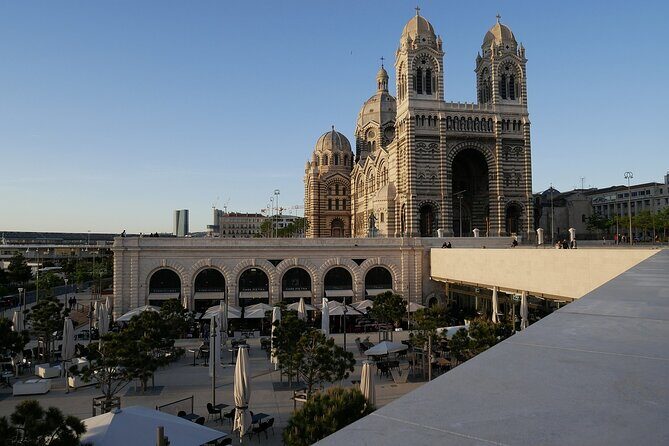
This tour is built for people who want the highlights without turning the day into a museum crawl. The pitch is 1 hour 30 minutes, but the walk can stretch if your guide is giving extra context or if you’re asking questions. I’d think of it as a flexible “about half a morning” experience: enough time to see major landmarks and understand what they mean, not so long that you feel drained.
The value comes from where the tour spends its time. Instead of long waits or repetitive photo stops, you move between locations that connect Marseille’s layers: ancient remains, a historic hospital turned hotel, the old district streets, a signature cathedral, and the old port’s fort. You get a story arc, not a checklist.
Also, booking seems to be popular—you’ll often find people reserving about a month ahead (average booking lead time is 33 days). If you’re traveling in high season or you’re on a tight schedule, booking early helps you avoid “no slots left” frustration.
Other walking tours we've reviewed in Marseille


Start Point at Métro Vieux Port Marseille: Getting Oriented Fast

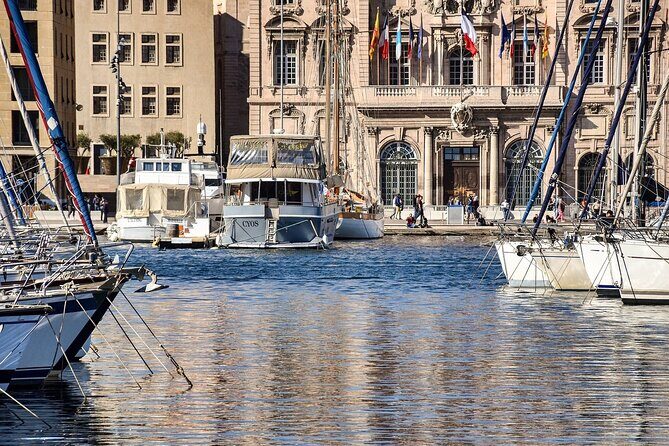
The meet-up is at Métro Vieux Port Marseille, and the tour ends back at that same point. That matters more than it sounds. Marseille’s center is easy to get turned around in, and returning to the same hub means you can confidently plan the next move: lunch, a harbor stroll, or continuing on with your own route.
The tour is offered in English, and you get a mobile ticket. Confirmation is received at booking, and the description notes it’s near public transportation—useful if you’re mixing this with other day plans.
One more practical point: a guide’s pre-tour contact can make a difference in a busy city. One account mentions the guide sending an exact location so the meet-up is easier to find. That’s the kind of small help that saves time.
Jardin des Vestiges: A Quiet Break From Street Noise
Your first stop is Jardin des Vestiges—a calm pocket tucked among real city streets. The whole point here is contrast. Marseille can feel loud and crowded; this garden shifts you into slower mode. As you walk the pathways, you’re surrounded by remnants of earlier eras, with moss-covered stones and weathered sculptural elements doing most of the talking.
What I love about this stop is how it makes history physical. Instead of hearing history as a lecture, you see fragments and try to imagine the layers underneath modern life. It also works as a reset early in the tour—good if you’re trying to beat the midday heat or you arrive a little frazzled.
Potential drawback: because it’s a walk-through garden, you’ll likely be moving at a slower speed than later checkpoints, and the ground may be uneven. Wear shoes you trust.
Hôtel Dieu Intercontinental Marseille: Hospital-to-Hotel, With Real Weight
Next up is Hôtel Dieu Intercontinental Marseille, a landmark tied to a former hospital that goes back centuries. Today it’s a luxury hotel, but the architectural presence is what hits first. You’ll be looking at a building that carries serious identity—stone, scale, and the kind of facade that tells you this site has always mattered.
This stop is less about interior sightseeing (since the tour description focuses on the historic facade and heritage feel) and more about context. Your guide helps connect why a hospital would sit so centrally in Marseille’s past and how the building’s meaning shifted over time.
The practical side: it’s a good photo area from the street, and it’s also a nice “pause” before you move into narrower streets and more walking. If you prefer your tours to mix big architectural moments with smaller street segments, this one does that.
Le Panier: Old District Streets and Small-Square Energy
Then you’re in Le Panier, described as Marseille’s oldest district, where narrow lanes and hidden squares make you slow down. This is where the tour becomes more “walk like a local” than “stand and look.” You’ll pass cafes, artisan shops, and side streets that feel like they’ve been lived in for generations.
Why it’s worth your time: Le Panier isn’t just pretty alleys. It’s a place where Marseille’s day-to-day life shows through. Your guide’s job here is to explain how the neighborhood’s structure—its twists, turns, and pockets of open space—shaped the way people move and gather.
Potential drawback: this is exactly the kind of area where steps and short climbs can show up. Even if you’re generally fine walking, this section can be tiring if you’re not used to city elevation and tight footpaths.
Other walking tours we've reviewed in Marseille





Cathedrale de la Major: Sunlight, Stained Glass, and Skyline Presence
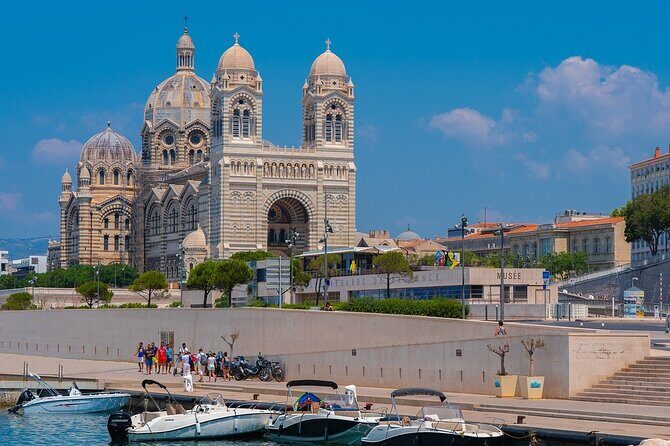
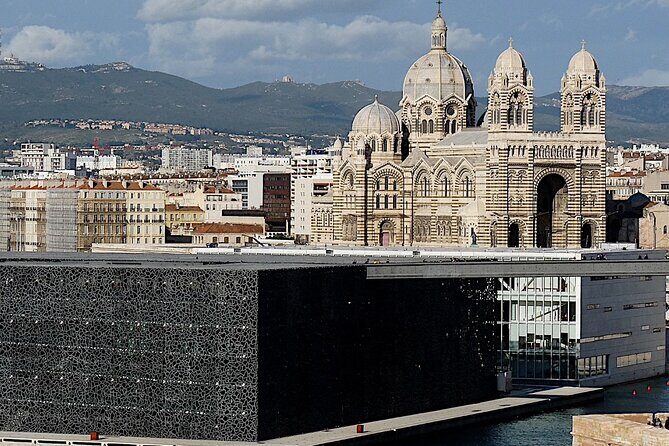
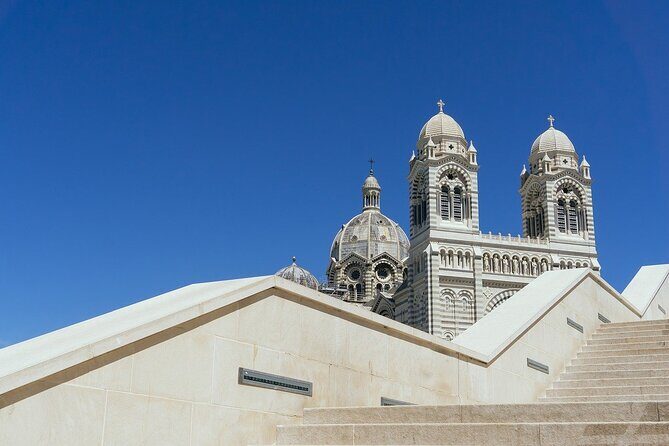
Cathedrale La Major is the kind of landmark you spot from a distance, with spires and an impressive scale that dominate the skyline. In the tour description, the experience inside is tied to how light filters through stained glass windows. That’s the moment to watch for: you’re not just looking at architecture, you’re watching how the interior changes your mood.
This stop works for three kinds of travelers:
- If you like art and light, it delivers a real visual payoff.
- If you want a spiritual or cultural anchor, it gives Marseille a clear reference point.
- If you’re history-focused, it offers a way to connect religion, city identity, and architecture.
Practical note: cathedrals often mean you’ll walk in and out of doors and stand still at times. That’s usually manageable, but it’s smart to keep expectations realistic if you’re traveling with limited energy.
Fort Saint-Jean at the Old Port: Maritime Marseille on a Viewpoint
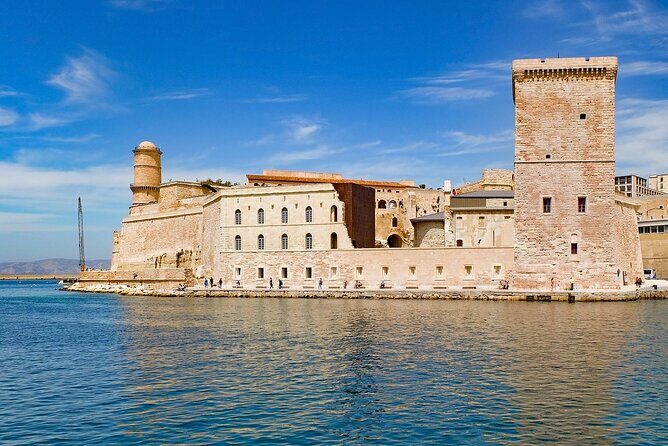
Next comes Fort St Jean, at the entrance to Marseille’s old port. Built in the 17th century, it’s described as a sturdy reminder of maritime roots, and it gives panoramic views of the Mediterranean. Even if you’re not into fortifications, the big value here is perspective—literally.
Your guide frames it as a “maritime history to present-day port life” connector. The fort has been transformed into a cultural hub, with exhibitions and events breathing life into the older spaces. On a walking tour, that’s a smart way to show that history isn’t frozen; it gets reused.
What to pay attention to:
- The way the fort overlooks the port area
- The sense of security and strategy implied by the placement
- How your viewpoint shifts you from street-level texture to harbor-scale understanding
This stop also tends to be a strong photo moment. If you’re traveling with a camera phone, you’ll likely want a pause here for skyline and sea views.
The Extra Stop at 9 La Canebière: Stitching Together the Route
There’s one additional stop along the way, listed as 9 La Canebière. The tour description doesn’t spell out the exact theme of this final checkpoint, but that’s not unusual for walking tours. These “route-stitching” stops help your guide keep the narrative coherent as the streets change character.
Think of it as a way to connect dots: after you’ve seen the garden remnants, the cathedral, the district streets, and the port fort, you’re often ready for a final bit of orientation. La Canebière is a named reference point on this walk, and it helps ground you in the center of Marseille.
Price and Value: What $36 Buys You in Marseille
The price is $36.00 per person, and that’s a lot easier to judge when you look at what’s included. You’re paying for a professional guide and the walking time—1.5 hours is the target.
The value gets stronger because the tour lists admission ticket free for the sites along the route. That means you’re not stacking on extra entrance fees just to get the “full experience.” For many city walks, you end up paying for entry to something you only spend 10 minutes at. Here, the structure is designed so the guide’s context does the heavy lifting.
Add in the small group limit (max 20) and the fact that the tour runs in English with mobile tickets, and $36 starts to look like a straightforward deal for a high-impact orientation walk.
One more value signal: guides are repeatedly described as friendly, helpful, and entertaining, and one account even notes the tour ran longer than booked and still felt like good value. That usually means the guide is actively working the group, not just reading a script.
Who This Marseille Walking Tour Fits Best
This is a great match if you:
- Want a quick way to understand Marseille’s geography: old port area, Le Panier, and major landmarks
- Like walking history where the city layout matters
- Prefer a guide who connects sights to meaning, not just facts
- Need an English tour with a small group and simple ticketing
It may be less ideal if you:
- Struggle with stairs or uneven streets. One account specifically warns that there are lots of steps, and the tour may not work well for someone with mobility limitations.
- Have extremely tight timing afterward, because the tour can run a bit longer than 90 minutes.
If you’re comfortable walking and you want a guided route that makes future self-guided exploring easier, this is an efficient choice.
Should You Book This Marseille Walking Tour?
I’d book it if you want an efficient, guide-led introduction to Marseille that mixes landmark scale with neighborhood streets. The big strengths for me are the free-entry stops, the consistently praised guide energy (Fabian/Fabien/Febian names show up in accounts), and the route that helps you connect the dots between the old port, Le Panier, and the cathedral.
Skip it or plan carefully if stairs are a dealbreaker for you. Otherwise, grab your spot early if your dates are fixed, and come with comfortable shoes. You’ll finish with better context and a clearer sense of where to go next.
FAQ
How long is the Marseille walking tour?
It’s listed as about 1 hour 30 minutes.
How much does it cost per person?
The price is $36.00 per person.
Is the tour in English?
Yes, the tour is offered in English.
Where do I meet, and where does it end?
The tour starts at Métro Vieux Port Marseille and ends back at the meeting point.
Is the ticket mobile, and will I get confirmation?
Yes, it uses a mobile ticket, and you’ll receive confirmation at the time of booking.
Are there admission fees at the stops?
The tour descriptions list admission ticket free at each stop.
Is the group size limited?
Yes. The maximum group size is 20 travelers.
FAQ
What’s the cancellation policy?
You can cancel for a full refund up to 24 hours before the experience starts.
Are gratuities included in the price?
No. Gratuities are optional.
Is the tour suitable for people with mobility issues?
Most travelers can participate, but there are a lot of steps, so if you have trouble walking, you may want to consider another option.
Are service animals allowed?
Yes, service animals are allowed.
Is it easy to get to using public transportation?
Yes. It’s noted as being near public transportation.